
Is It Life or Is It Zoom?

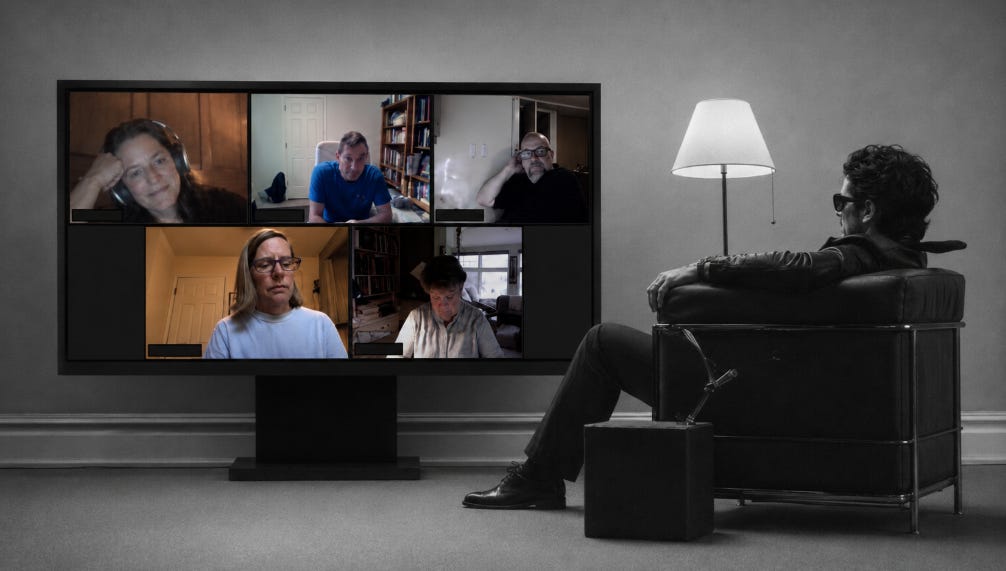
During COVID-19, I started meeting online every six to eight weeks with some guys I know from summer camp. I’ve known some of them since 1969, when we were bunkmates at Trails’ End Camp (TEC). We normally meet at 1:30 p.m. on Sundays, and the conversation was still going strong when I bowed out at 2:15 p.m. to nap before my 3:00 p.m. review with my Substack editor, Peter.
In the interest of efficiency, I often reuse the same Zoom link that is configured so there’s no waiting room and doesn’t require the host to attend. It’s an interesting group of guys—we can shift in seconds from something that happened more than 50 years ago and kid each other, and then console one of us, a TV writer, about how he’s coping with the loss of his home from the Palisades wildfires in 2024. One guy produces sports documentaries for ESPN; another is a mostly retired emergency room physician. They were among the most enthusiastic supporters of my Substack launch, and after a few posts, one of the guys said, “I expected it to suck and it didn’t.” All this is to say, we know each other well.
My alarm did not go off as expected, so I overslept. As I was frantically logging in, I saw a text from Peter that said, “I’m online with your camp buddies.” So, there it was: four of my camp besties meeting on Zoom with my college roommate and present-day Substack editor, with nothing else to talk about but me. I didn’t think the TEC call would last an hour and a half. I’d never have considered introducing them to Peter, but it was beyond my control. After sharing details of my long-standing personality quirks, the TEC crowd expressed their disappointment that I hadn’t yet written a story about them. Somehow, Peter started talking about his heart transplant. I wish I had a recording of the call.
Like many people, I became an involuntary frequent Zoom user during COVID. Unlike others, I’ve adopted a Zoom-heavy lifestyle since then, and it’s been a game changer for me. In addition to my TEC and Substack review meetings with Peter, I’m a twice-weekly participant in a live online group resistance-training program called Vivo. After six years of working out with the same trainer and some of the same clients, we’ve reached a point where it feels more like friends just hanging out rather than a 45-minute workout. A bonus for me is that my out-of-state brother is a regular participant, too.
With my hearing impairment, the sessions are more interactive for me than they would be in person because everyone has a microphone, and I can hear what they’re saying. Also, the closed captions are incredible. More importantly, as a failed amateur comedian, I have a captive audience. Since the program is specifically designed for people over 55, the workouts include dual-task questions to improve cognitive-motor integration. By answering these questions, we share details of our lives such as our first car, our favorite mentor, and our favorite vacation spot. Over the years, sharing these revelations has created close bonds.
When our trainer, who frequently expresses his dislike of me, mentioned that his cat was snoring behind him, I suggested he get a CPAP machine for his pet. Knowing that mental health and longevity experts recommend multiple interactions with friends each week, I’ve asked my Vivo cohorts if I can “count” them as friends; they agreed, but reluctantly. My wife and I have met several of my Vivo classmates in person, and I’ve even stayed at a couple’s apartment during a recent trip to New York City.
Besides helping me reconnect with old buddies and make new ones, Zoom helped my neighbors and me continue our weekly yoga sessions during COVID. It does have downsides—one woman joined a scheduled online gathering without headphones in the midst of a hectic Sunday brunch, thereby sharing all the background noise with everyone. I hadn’t signed in as the host, so I didn’t have muting capabilities. When I’m signed in, I never feel more powerful than when I’m hosting. Wouldn’t it be wonderful to mute someone in real life?
More than anything else, Zoom has brought new people into my life and reinvigorated my interest in writing. After a 25-year hiatus from formal writing instruction, I took an online class in January of 2021. Although I completed three courses with the same instructor, I realized the format wasn’t forcing me to write as regularly as I wanted. I reached out to one of the other students, Molly, to propose that we hold each other accountable to write more.
Our small writing partnership later expanded to include two other students we had met in our class, Rachel and Sheila, and my former roommate and erstwhile editor, Peter. Molly and I met on Zoom monthly, which forced both of us to write at least that much. She pointed out that my five-page pieces rambled and that my true voice and personality didn’t come through. She mailed me a hard copy of an article by an author whose style was similar to mine. The piece was funny and authentic, and Molly was gentle and supportive in her efforts to coax me to share more of myself. The article and Molly’s feedback had a major impact on me.
Sharing personal essays forces vulnerability, and all five of us got to know each other in a way that doesn’t usually happen with a collection of mostly strangers. Molly shared tales of hospital-gurney lovemaking during her internship, a boyfriend who repurposed a canoe as living-room furniture, and her spur‑of‑the‑moment graduate‑school marriage to get a better apartment lease. More than anyone else, she helped me understand how women who choose not to have children are mistreated and undervalued. At the end of 2024, we all considered getting together in person, but we were unable to coordinate our schedules.
In October of 2025, shortly before one of our monthly gatherings, Molly emailed all of us, “I won’t be there. I have an ‘aggressive brain tumor’ not sure what it will mean yet.” A few weeks later, when she didn’t return my calls, I dialed Molly’s home phone and spoke to her husband, who told me that she was in surgery that day. I told him to share that we were thinking about her and wishing for a speedy recovery. I only heard back from her once, when she left me a voicemail in December. Fearing the worst, I periodically checked the obituaries, and I found out that she had passed away in March of 2026. It surprised me that her obituary didn’t mention her writing, although it was an important part of her life.
Without Zoom and Molly, Schwartz Shorts would not exist. Molly and I never managed to meet in person. When I learned she had died, I spent the day grieving someone I’d only known through a screen. I saved that last voicemail, and I’m not ready to listen to it again. It didn’t matter whether it was life or Zoom; Molly and I had a meaningful friendship.
Have you made any friendships that are exclusively online?
Have any of your worlds ever collided either intentionally or unintentionally?
This is a gentle story with a rough, but well executed twist. I’m very sorry for your loss, but delighted for what you’ve gained.
I am so sorry you've lost a dear friend and true writing partner. She sounds like a remarkable woman. I'll now think of Molly very time I read one of your "Shorts." And, yes, circumstances of a mutual friend connected me with someone I've become quite close to just speaking over the phone for a number of years. I hope someday to meet her in person and celebrate our mutual friend.